
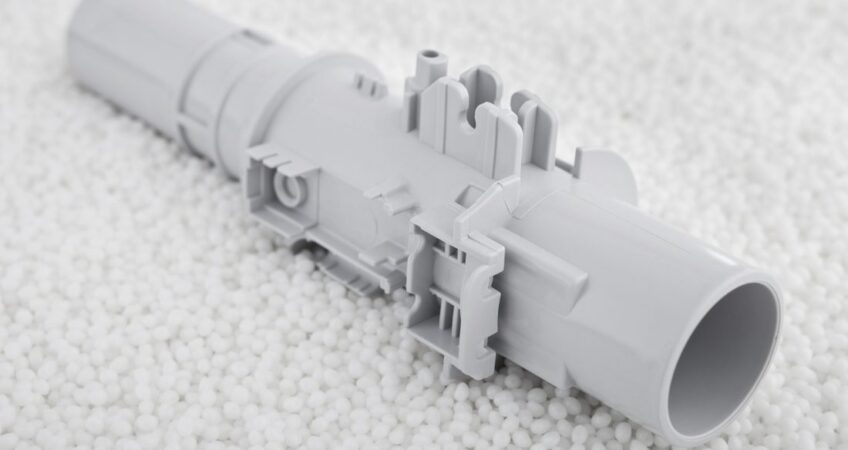
Injection moulding is a mature process. Melted plastic is pushed into a steel mould, cooled and ejected, millions of times over. What is changing is everything around that cycle: who sets the machine, how the mould is cooled, what the plastic is made from, and what else can be moulded into the part.
This article explains those changes in plain language. Most of them were on show at K 2025, the plastics industry’s main trade fair, in October 2025. At the end we say what they mean if you buy moulded parts for your own products.
The short version
Machines are starting to set themselves. ENGEL showed a moulding cell that adjusts its own settings and says it can save up to 5% of the material.[1]
Electric machines use far less power. One measured comparison found an all-electric machine used about a quarter of the electricity of a hydraulic one per pound of plastic.[4]
3D-printed cooling channels shorten the cycle. Published savings run from 8% to 66%, so the gain depends heavily on the part.[6, 8]
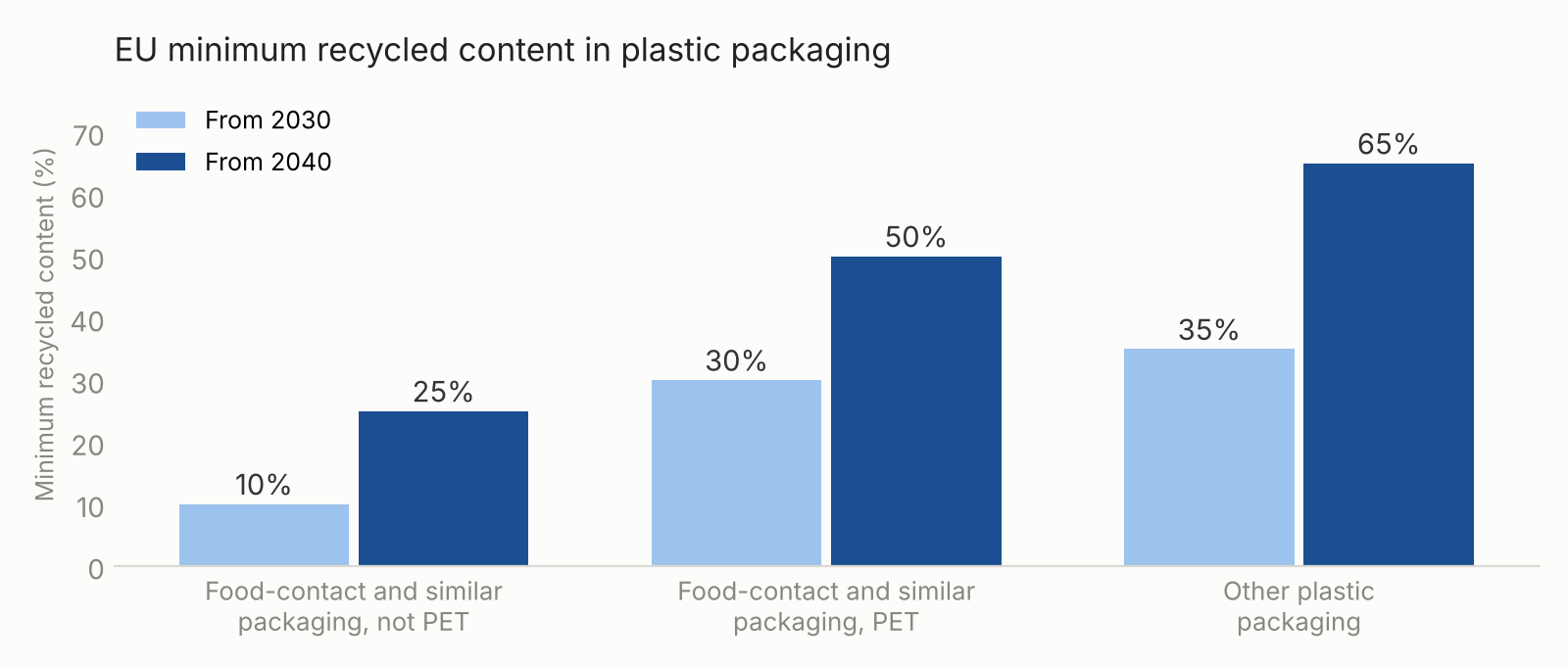
Recycled plastic is becoming a rule. From 2030 the EU requires 10% to 35% recycled content in plastic packaging.[10]
1. Machines that set themselves
Setting up a moulding machine has always depended on a skilled setter adjusting pressures, speeds and temperatures until the parts come out right. Those people are getting harder to find.
At K 2025 ENGEL presented what it calls the first autonomous injection moulding cell. The machine regulates itself, with AI support, to hold part quality. ENGEL says it can save up to 5% of the material by running closer to the lower tolerance limit.[1] A related tool watches up to 1,000 process values on every shot and suggests corrections, and a built-in assistant answers operators’ questions from the machine’s documentation.[2]
These are the maker’s own claims, so treat the numbers with care. But independent research points the same way. A 2026 study compared three ways of predicting part quality. A simple statistical model using machine data was off by 0.95% on average. A machine-learning model fed by sensors was off by 0.27%. Computer simulation did well in normal conditions but struggled when the mould did not fill completely.[3] The practical lesson is that sensors in the process are what make the predictions accurate.
2. Electric machines
Older machines are driven by hydraulic oil, which is pumped all the time, even between shots. All-electric machines use servo motors that draw power only when something moves.
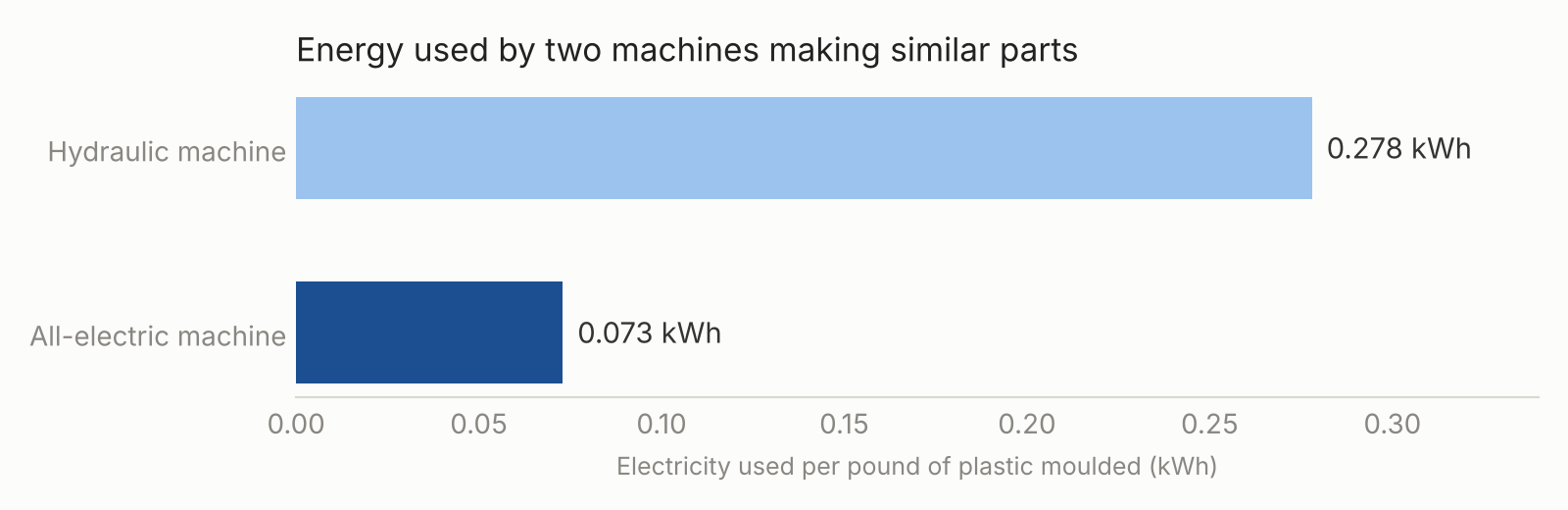
In that measurement the electric machine used roughly a quarter of the energy. The trade magazine Plastics Technology gives a typical range of 50% to 75% less, and says all-electric machines now make up more than half of the injection moulding machines sold each year in the United States.[5] Newer hydraulic machines with servo-driven pumps have closed part of that gap, so the saving on a modern machine will be smaller than the chart shows.
For a buyer this matters in two ways. Energy is part of the part price. And electric machines repeat each shot more exactly, which helps with tight tolerances.
3. Cooling the mould faster
Most of the moulding cycle is spent waiting for the plastic to cool. Cooling water normally runs through straight holes drilled in the mould, which cannot follow a curved part closely. With metal 3D printing, a mould insert can be built with channels that curve around the part. This is called conformal cooling.
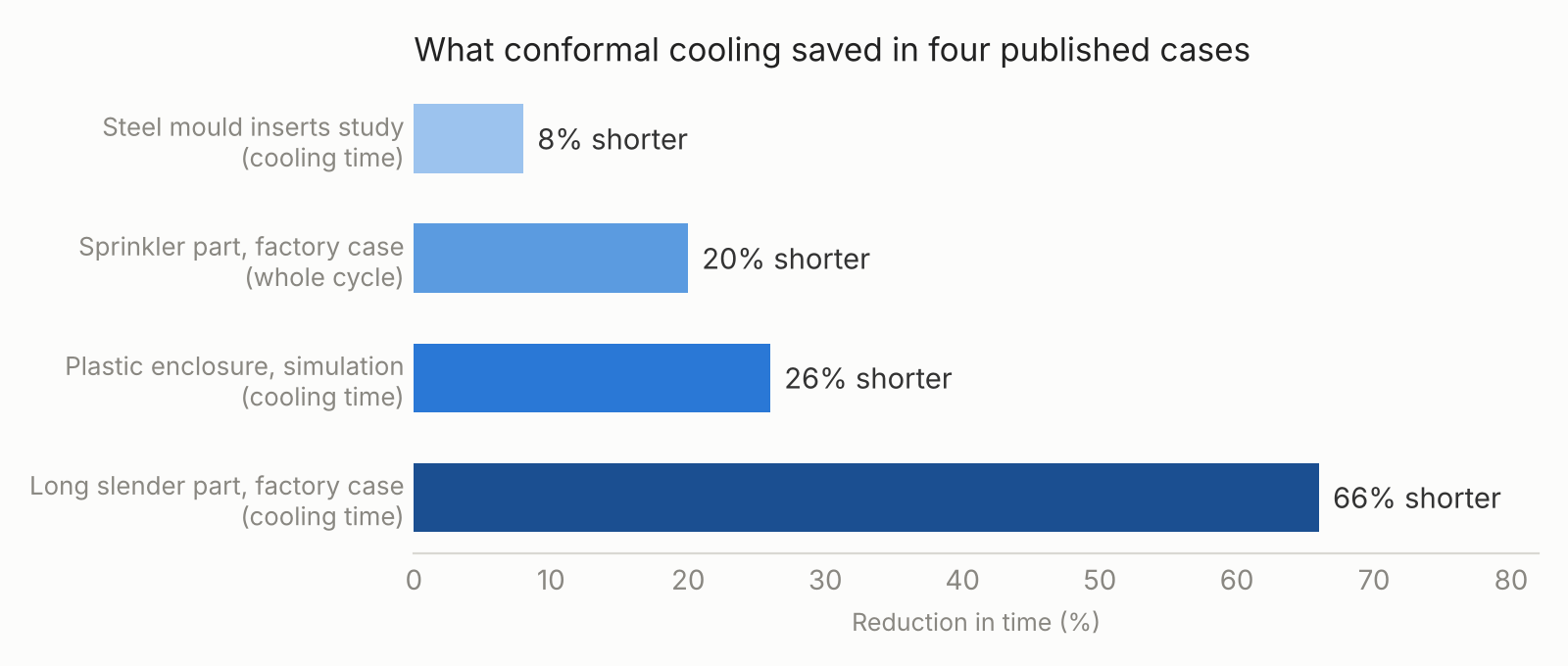
The spread is the point. A review of earlier work puts the usual saving in cooling time at 15% to 50%.[6] A simple, thin part gains little. A thick or awkward part, where drilled holes cannot reach, gains a lot. Conformal inserts cost more than drilled ones, so they pay back only on high volumes or difficult parts.
4. Recycled plastic and new ways to add glass fibre
From 2030 the EU’s packaging regulation sets minimum amounts of recycled plastic in packaging, and raises them in 2040.[10, 11]
Recycled plastic varies from batch to batch, which makes it harder to mould consistently. This is where the self-adjusting controls in section 1 earn their keep. ENGEL showed a part moulded from 100% post-consumer recycled plastic at K 2025, using a control that corrects each shot for the changing material.[12]
The rule covers packaging, not engineering parts. But it will change which recycled grades are available and what they cost, and many buyers of other products are setting their own targets.
A second development is about strength. Parts are often reinforced with glass fibre, bought already mixed into the plastic pellets. KraussMaffei showed a process that feeds plain polypropylene and loose glass fibre straight into the moulding machine. The company says this can cut material cost by up to 30%.[13] Again, that is the maker’s figure.
5. Electronics moulded into the part
In-mould electronics puts the circuit inside the plastic. Conductive tracks are printed on a flat film, small parts such as LEDs are fitted, the film is formed into shape, and plastic is moulded over it. The result is a single thin part with touch controls and lighting built in, with no separate buttons or circuit board.
TactoTek, a developer of the method, describes structures 2 to 3 mm thick and up to 70% lighter than a conventional assembly.[14] An EU-funded project called MULTIMOLD has gone further and moulded over sensitive parts including batteries, to make sealed sensors that power themselves.[15]
The open problems are the heat and pressure of moulding, which can damage the film and parts, and recycling, since the finished piece mixes plastic, metal and electronics. The same EU project lists recyclability by design as one of its goals.[16]
What this means if you buy moulded parts
| If your part | What to consider | What to ask your supplier |
|---|---|---|
| Has tight tolerances or must look perfect | Process control matters more than the machine’s age | Which values are monitored on every shot, and what happens when one drifts |
| Is thick, deep or awkward to cool, in high volume | Conformal cooling inserts may shorten the cycle | Whether a cooling simulation was run, and what a conformal insert would add to the mould cost |
| Must contain recycled plastic | Recycled grades vary, so colour and strength can shift between batches | Which recycled grade is proposed, and how batch changes are handled |
| Needs glass-fibre strength | Fibre length affects strength, and it depends on how the material is processed | The fibre content, and test results on moulded samples, not only the data sheet |
The suggestions in this table are our view. They are not taken from the sources above.
Where P&A fits
Nothing in this article is a claim about our own products or our partners’ machines. P&A International designs and supplies custom injection moulded parts for equipment makers, from mould design and prototypes to production. We have them made across a partner network where every supplier is ISO 9000 certified or better. More detail is on our injection moulding page, and our list of ten injection moulding companies in China shows who else to ask.
Have a plastic part to quote?
Send us your 3D file, material, finish and quantities. One dedicated engineer replies with a proposed design and indicative pricing, typically within 48 hours.
Request a quoteSources 16 references, click to show
- ENGEL press release, inject AI and the autonomous injection moulding cell, 18 September 2025
- Plastics Machinery & Manufacturing, ENGEL at K 2025, 8 October 2025
- International Journal of Advanced Manufacturing Technology (2026), cross-method study of quality prediction in injection moulding
- ACEEE Summer Study (2005), "The Promise of All-Electric Injection Molding Machines: A Promise Kept?"
- Plastics Technology, "What Is an All-Electric Injection Molding Machine?"
- Polymers (2023), conformal cooling layouts for complex slender parts, with review of earlier results
- Plastics Engineering, "How Xact Metal Conformal Cooling Cut K-Rain Cycle Time 20%", December 2025
- Materials (2020), redesign of cooling inserts for high-production steel moulds
- University of Central Lancashire manuscript, conformal cooling layers
- TOMRA, "Recycled content targets: What the PPWR means for packaging's future"
- Berlin Packaging, "Understanding the EU's Packaging and Packaging Waste Regulation"
- Rubber World, ENGEL at K 2025: efficiency, precision and AI
- Plastics Machinery & Manufacturing, KraussMaffei Chopped Fiber Processing
- Altium, "Injection Molded Structural Electronics" (TactoTek session)
- EFFRA, "MULTIMOLD: Advancing In-Mold Electronics for Next-Generation Manufacturing"
- European Commission CORDIS, MULTIMOLD project
Figures were read from these sources on 24 November 2026. Company figures are the companies’ own claims and research figures come from single studies. Charts are original drawings by P&A International from the data cited under each one.