
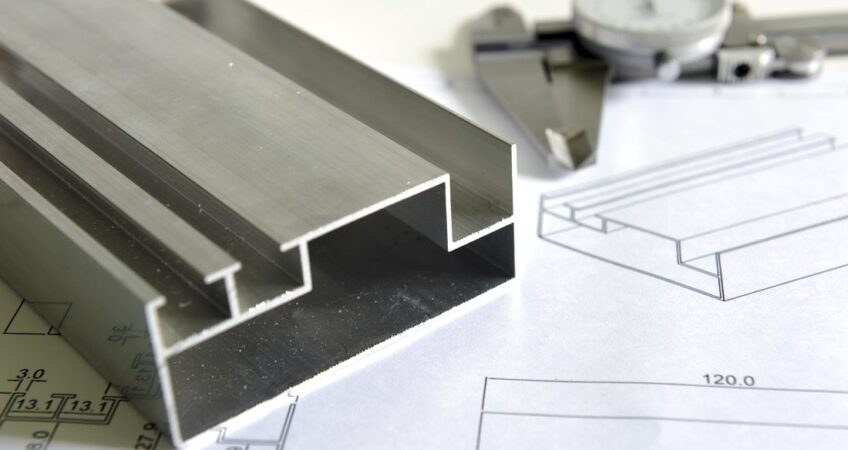
Extrusion is a simple idea. A heated aluminium log, called a billet, is pushed through a shaped steel die and comes out as a long profile with that cross-section. Window frames, machine frames, enclosures, heat sinks and trim are all made this way.
The process has not changed much. What has changed is everything around it: the duties charged at the border, the carbon paperwork, and the price of the metal. For a buyer of profiles made in China, those three now matter as much as the drawing. This article sets them out in plain language. It is general information, not customs or legal advice, and the rules change often.
The short version
The EU, the US and Australia all charge extra duty on extrusions from China. The EU’s rates run from 21.2% to 32.1% and are under review.[1, 2]
The US charges 50% on the full value of articles made of aluminium, and 25% on some products made partly of it. That has applied since April 2026, on top of older duties aimed at China.[6, 7, 8]
The EU now prices the carbon in imported aluminium. Its border carbon charge moved from reporting to paying on 1 January 2026.[4]
The metal source decides the carbon footprint. One industry study puts a profile at about 8 kg of CO2 per kg with hydro-powered metal and about 17 with coal-powered metal.[10]
1. Duties at the border
Three large markets apply trade measures to aluminium extrusions from China. They work differently, and more than one can apply to the same shipment.
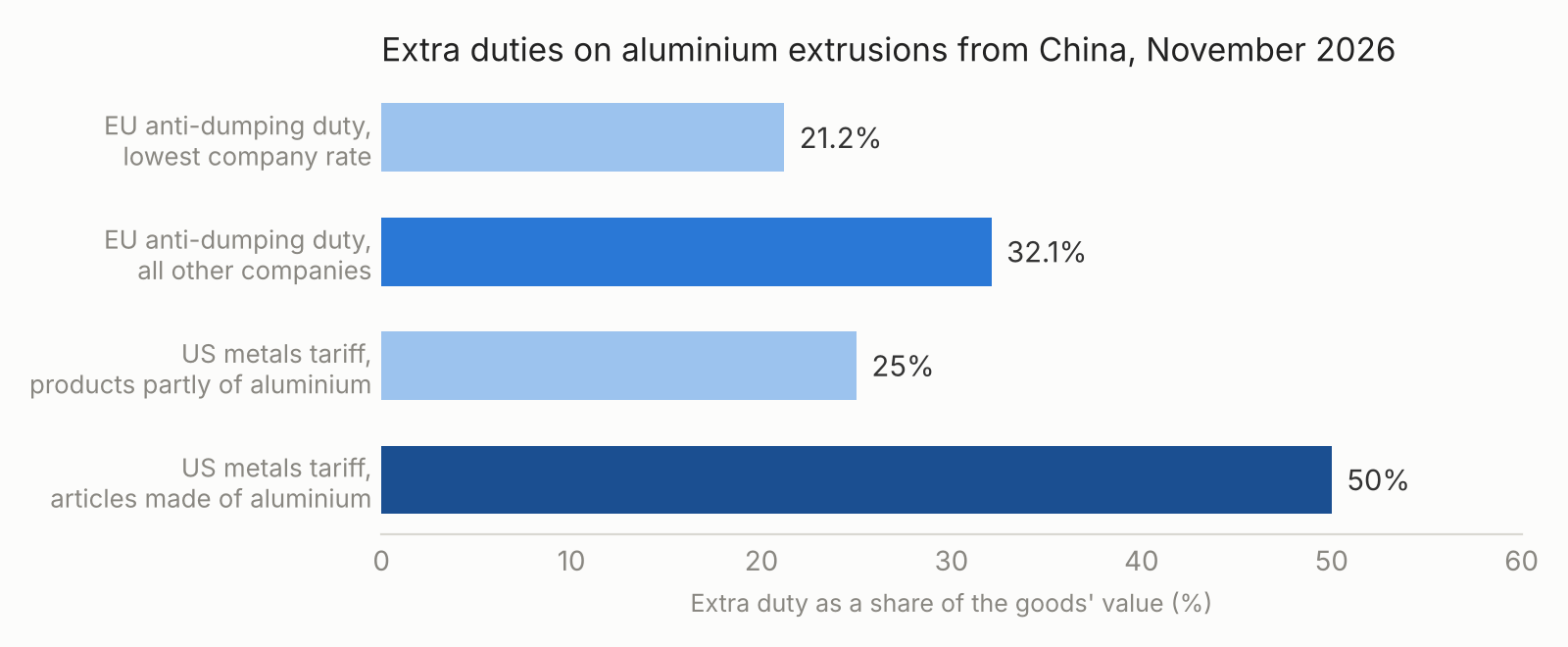
European Union. Anti-dumping duties of 21.2% to 32.1% have applied to aluminium extrusions from China since March 2021.[1] They were due to lapse at the end of March 2026. European producers asked for them to be kept, and the Commission opened an expiry review on 26 March 2026, which is still running.[2, 3] The duties stay in place while it does.
United States. Two layers apply. The first is a metals tariff, known as Section 232, which covers aluminium from almost every country. Since 6 April 2026 it has been charged on the full customs value of the goods: 50% for articles made entirely or almost entirely of aluminium, and 25% for a list of products made partly of it.[6, 7] Some countries have lower rates. The second layer is specific to China: anti-dumping and anti-subsidy orders on aluminium extrusions, in force since May 2011 and continued in 2022.[8] Both layers can be charged on the same shipment.
Australia. Anti-dumping and anti-subsidy measures on aluminium extrusions from China began on 28 October 2010. In October 2025 they were continued for a further five years, to 28 October 2030. The register also lists measures on extrusions from Malaysia and Vietnam.[9] The rate depends on the exporter.
Which measure applies to a given part depends on its tariff code, on where it was made, and sometimes on how far it has been machined or assembled. A cut and drilled profile is usually still an extrusion for these purposes. A finished, assembled product may not be. This is a question for a customs broker before an order is placed, not after the goods are on the water.
2. The EU’s carbon charge
The EU’s Carbon Border Adjustment Mechanism, or CBAM, puts a price on the carbon emitted in making certain imported goods, aluminium among them. From 2023 to 2025 importers only had to report. Since 1 January 2026 they must be authorised, declare the emissions in what they import, and buy and surrender certificates to match.[4]
The money does not change hands straight away. Certificates covering 2026 imports go on sale in February 2027, and the first declarations are due by September 2027.[5] But the liability builds from the day the goods arrive. Importers of less than 50 tonnes of covered goods a year fall under a threshold.[4]
For a buyer, this means the importer of record will ask the supplier for emissions data. Where real data is missing, default values are used, and these are generally less favourable than real figures.
3. Carbon footprint and recycled metal
Most of the carbon in a profile comes from making the metal, not from extruding it. An industry-wide study by the Aluminum Extruders Council in North America found that raw material accounts for about 75% of the footprint of a plain profile and the extrusion process about 25%. Anodising adds about 5% and painting about 14%.[10]
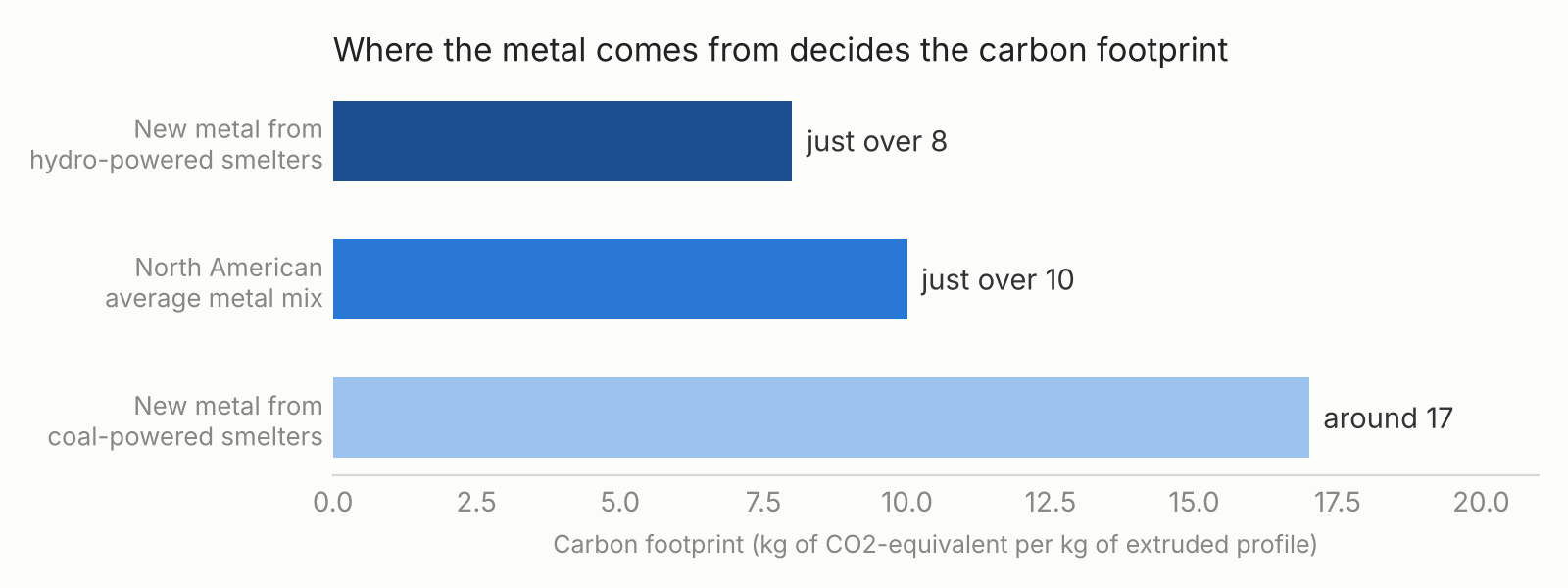
That study assumed billet made of 53% recycled and 47% new metal, the North American average.[10] Raising the recycled share lowers the footprint further, because remelting scrap emits about 0.52 tonnes of CO2-equivalent per tonne against 15.1 tonnes for new metal.[11]
“Low-carbon aluminium” has no single legal definition. In practice it means a high share of recycled metal, new metal from smelters run on hydro or other clean power, or both. The proof buyers are usually given is an Environmental Product Declaration, a standard document that states the footprint and how it was calculated.
4. The metal price
An extrusion quote starts from the aluminium price on the London Metal Exchange. On top of that come a regional premium for delivered billet, the cost of extruding, and finishing.
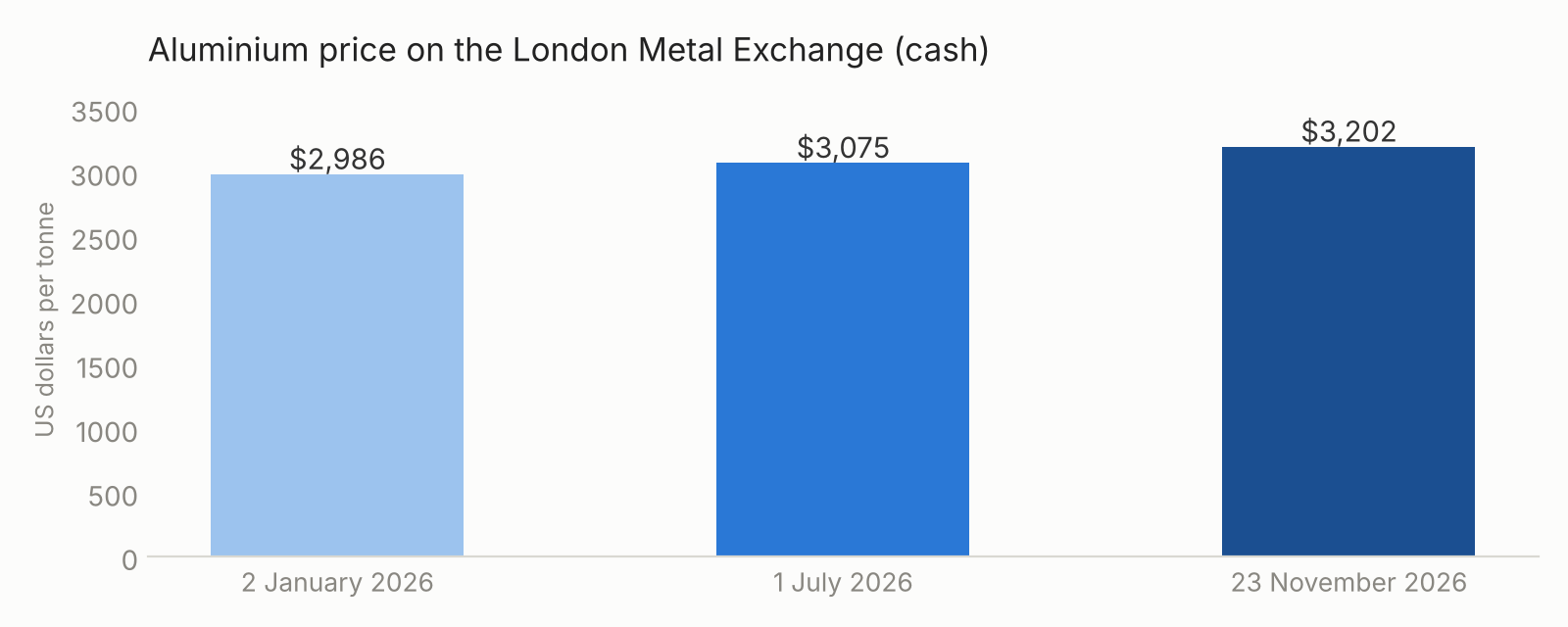
That is a rise of about 7% over the year. It is far smaller than the duties in section 1. For a buyer importing into the EU, the US or Australia, the trade measures move the landed cost much more than the metal price does.
5. Alloys, tolerances and finish
Most profiles are made from three alloys. 6063 is the easiest to extrude and gives the cleanest surface for anodising, so it is the usual choice for frames, trim and heat sinks. 6061 and 6082 are stronger and are used for structural and machined parts, but they are harder to push into thin or complicated shapes.
A new profile needs its own die, which is a one-off cost spread over the order. Tolerances follow published standards, EN 755-9 for general profiles and the tighter EN 12020-2 for precision profiles in 6060 and 6063. Asking for tighter limits than the standard on every dimension raises the price. Asking for them only where the part needs them does not.
Anodising gives a hard, metallic finish in a limited range of colours. Powder coating gives almost any colour and hides small surface lines.
What this means if you buy extrusions
| If you | What to consider | What to do or ask |
|---|---|---|
| Import into the EU, US or Australia | Duties can exceed the metal cost difference between suppliers | Get the tariff code and country of origin confirmed, and ask a customs broker which measures apply before ordering |
| Import into the EU | The carbon charge builds from the day goods arrive | Ask the supplier for emissions data for the billet and the profile, so default values are not used |
| Have a carbon or recycled-content target | The metal source matters far more than the extrusion step | Ask for the recycled share and an Environmental Product Declaration |
| Need a quote to hold | The metal price and premiums move | Ask what aluminium price the quote is based on and how long it is valid |
| Are designing a new profile | Alloy and tolerance choices set the cost | Say which dimensions are critical, and ask whether 6063 would do the job |
The suggestions in this table are our view. They are not taken from the sources above.
Where P&A fits
P&A International designs and supplies custom aluminium extrusions, cut, machined and finished to your drawing. Our profiles are made in China, so the measures described above are relevant to them, and we would rather you checked before ordering than after. Nothing in this article is a claim about our own products or our partners’ factories. We have profiles made across a partner network where every supplier is ISO 9000 certified or better. More detail is on our aluminium extrusion page, and our list of aluminium extrusion companies in China shows who else to ask.
Have a profile to quote?
Send us your drawing, alloy, finish, quantities and the country you are shipping to. One dedicated engineer replies with a proposed design and indicative pricing, typically within 48 hours.
Request a quoteSources 12 references, click to show
- European Commission, "Commission imposes anti-dumping duties on imports of aluminium extrusions from China", 30 March 2021
- European Commission trade investigations register, case AD664 aluminium extrusions, expiry review R850
- Mysteel, "EC launches expiry review of AD measures on Chinese aluminium extrusions", 2 April 2026
- European Commission, Carbon Border Adjustment Mechanism (CBAM)
- S&P Global, "Europe's CBAM goes live as importers grapple with rising carbon costs", 7 January 2026
- Sandler, Travis & Rosenberg, "Section 232 Tariffs on Steel & Aluminum" (tracker)
- EY, "US presidential proclamation modifies Section 232 tariffs on steel, aluminum, copper and their derivative products", 3 April 2026
- US Federal Register, "Aluminum Extrusions From the People's Republic of China: Continuation of Antidumping Duty Order and Countervailing Duty Order", 2 November 2022
- Australian Anti-Dumping Commission, Dumping Commodity Register: aluminium extrusions
- Light Metal Age, "Aluminum Extrusion EPDs and the Push for Decarbonization", May 2023
- International Aluminium Institute, recycling and greenhouse gas emissions fact sheet
- Westmetall, LME aluminium cash settlement prices
Figures were read from these sources on 24 November 2026. Duties, carbon rules and prices change often; check the current position before relying on them. Section 5 draws on general engineering knowledge. Charts are original drawings by P&A International from the data cited under each one.